
Processing...
Homeowner Guide · June 1 – November 30
Hurricane season AC prep for SWFL homes
Ian taught this coastline what a storm does to an air conditioner. Most of the damage we repaired afterward wasn’t wind — it was the power flicker, the flooded condenser, and the restart that shouldn’t have happened. Here’s the checklist, before, during, and after.
Real person answers — before, during & after the storm
FL Lic. CAC1820344
★ 4.9 on Google
SWFL Only
★ 4.9 on Google
SWFL Only
Before the storm · when the cone shows up
Five jobs to do while the sky is still blue
- 1. Cool the house hard, early. Set the thermostat 3–4 degrees lower than usual the day before landfall. If FPL goes down, a cold, dry, sealed house buys you a day or two of comfort — and slows the humidity that starts mold in a closed-up Florida home.
- 2. Put a surge protector on the condenser. This is the big one. The #1 storm killer we see isn’t wind or water — it’s the power flicker. Grid power sags, drops, and slams back during a storm, and that surge cooks compressors and control boards. A dedicated HVAC surge protector at the disconnect is a small part that protects a five-figure system. We install them in one visit.
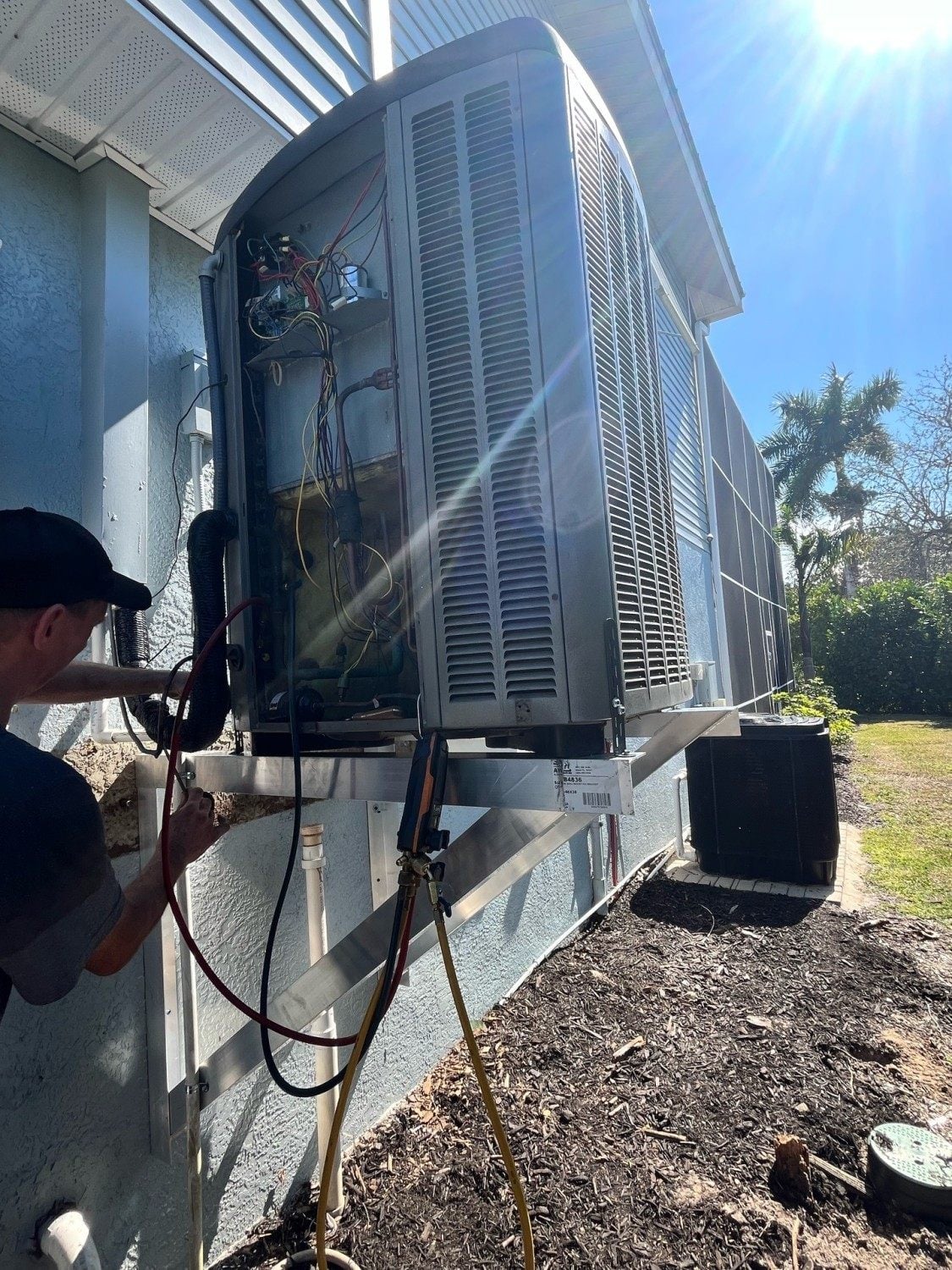
- 3. Check the condenser tie-down straps. Florida code requires outdoor units to be anchored against hurricane wind — hurricane straps or anchor bolts into the pad. Look for corroded, loose, or missing straps, especially on coastal units where salt air eats hardware. A 200-lb condenser that moves in 120-mph wind tears its own refrigerant lines out.
- 4. Clear the yard. Lawn chairs, potted plants, coconuts, dead palm fronds — at hurricane speed they’re projectiles, and the condenser’s thin aluminum fins lose that fight every time. Give the unit a clean 10-foot radius. Do not wrap or tarp it; trapped moisture does its own damage.
- 5. Know your breaker. Find the AC breakers in your panel now — usually two, one for the air handler and one for the condenser — and label them. In the dark, with the wind up, is a bad time to go looking.
Ten years old or older? A pre-season tune-up catches weak capacitors and loose connections before the grid stress-tests them. That’s part of every maintenance plan visit.
During the storm · landfall
Turn the AC off at the breaker. Here’s why.
It feels wrong to shut off the one machine keeping the house livable. Do it anyway, before conditions get bad — this is exactly what the hard pre-cool was for.
1
Kill both AC breakers
Flip the air handler and condenser breakers off before landfall. Power during a storm doesn’t just go out — it sags, flickers, and spikes. Every flicker is a surge event aimed at your compressor.
2
Leave them off through outages
When the grid comes back, it comes back ugly. Line crews restoring power create the biggest surges of the whole storm. A breaker that’s off can’t deliver one to your system.
3
Ride it out sealed up
Keep doors and windows shut. A pre-cooled house holds temperature for hours. Ceiling fans on generator power stretch it further — and use a fraction of what a condenser draws.
One exception: if you left the AC on and the power is flickering, it’s not too late. Shut the breakers off at the first flicker, not after the third.
After the storm · before you flip anything back on
The restart is where systems die
✕
Did water reach the condenser? Do NOT restart it. If storm surge or floodwater touched the unit — even a few inches — call before power-on. Saltwater shorts windings and corrodes contacts from the inside; energizing a flooded unit can turn a cleanable problem into a dead compressor. This one phone call is the cheapest insurance in this whole article: (239) 977-2010.
✕
Don’t start it full of debris. Look inside the top grille and around the coil for fronds, leaves, and shredded screen enclosure. A jammed fan blade burns out its motor in seconds. Clear what you can reach by hand — with the breaker still off.
✕
Listen on restart. Dry, clear, undamaged? Flip the breakers and stand by the condenser. Grinding, buzzing, or a hum with no fan means shut it back down. Running through a bad noise is how small storm damage becomes a major repair.
✕
Breaker trips? Stop. A breaker that won’t hold is telling you there’s a short somewhere in the system. Resetting it over and over feeds power into a fault. Leave it off and get a licensed tech out — we run 24/7 after storms.
The paperwork that pays
Document your AC like an adjuster will see it
Before: the June photo set
Every June, photograph the condenser from all four sides, the data plate with model and serial numbers, the straps, and the pad. Two minutes of phone photos proves the unit’s pre-storm condition.
After: shoot before you touch
Photograph damage, waterlines, and debris exactly as the storm left it — before cleanup, before repairs. Note the date and high-water mark. Adjusters pay on evidence, not descriptions.
The paper trail
Keep install receipts, maintenance records, and repair invoices in one folder. A documented service history is the difference between “covered storm damage” and “pre-existing wear” on a claim. Our written reports with photos do this for you automatically.
★★★★★ 4.9 from 127+ Google reviews — including the post-Ian ones.
After every storm, they show up
The “AC guys in a truck” and how to check them in 60 seconds
Why scams spike after storms
Thousands of dead ACs, brutal heat, and homeowners desperate to cool the house — it pulls unlicensed crews into SWFL from all over the country after every major storm. The pattern repeats: cash up front, a “replacement” you didn’t need, no permit, no warranty, and a phone number that stops answering by October.
- Door-knockers who “noticed your unit” — legitimate contractors are buried in calls after a storm, not canvassing
- Large cash deposits before any work
- No license number on the truck, the card, or the quote
- “We can skip the permit to save time” — that’s your red flag and their exit plan
Verify any license — including ours
Every legitimate Florida HVAC contractor holds a state license you can check for free, from your phone, in about a minute:
- Go to the Florida DBPR license search at myfloridalicense.com
- Choose “Search by License Number” and type the contractor’s number
- Try it on us right now: CAC1820344 — you’ll see Always Be Cooling, current and active
- No number, expired, or a name that doesn’t match the truck? Close the door.
We put our license on every page of this site because we want checking it to be normal. We serve Collier and Lee County year-round — we’re here before the storm and we’ll still be here five summers after it.
Do the prep once, before June
Want us to storm-ready your system?
One visit: surge protector installed at the condenser, tie-down straps inspected and tightened, drainage checked, and a photo report you can file with your insurance folder. Done before the first named storm has a name.
FL Lic. CAC1820344Licensed & InsuredFamily-Owned
Straight answers
Hurricane Season AC FAQs
Should I turn my AC off during a hurricane?
Yes — at the breaker, before landfall. Storm power flickers and the surges that come with restoration are the single biggest cause of the compressor and control-board failures we repair after storms. Pre-cool the house hard first, then shut off both AC breakers and leave them off until power is stable.
Is an AC surge protector really worth it?
It’s one of the few cheap parts that protects an expensive one. A dedicated HVAC surge protector at the disconnect absorbs the spikes that would otherwise hit the compressor and board — the two most expensive components in the system. In a place with 10 months of thunderstorms plus hurricane season, we consider it standard equipment, not an upgrade.
My condenser was under water. Is it ruined?
Not always — but do not turn it on to find out. Energizing a flooded unit can short windings and destroy a compressor that was salvageable. Saltwater surge is more serious than rain flooding because it keeps corroding after the water recedes. Leave the breaker off and call us at (239) 977-2010; we’ll inspect, clean, and test it safely before it ever sees power. See our guide on what salt air does to SWFL condensers.
Do condensers really have to be strapped down in Florida?
Yes. The Florida Building Code requires outdoor HVAC equipment to be anchored to resist hurricane winds — straps or anchor bolts rated for the load. Older installs and salt-corroded hardware are the usual failures. If you’re not sure yours meets code, we check anchoring on every maintenance visit.
Does homeowners insurance cover hurricane AC damage?
Wind damage generally falls under your hurricane coverage (after the hurricane deductible); flood and storm-surge damage usually requires separate flood insurance. Every policy differs — which is exactly why the before-and-after photos and service records matter. Good documentation moves a claim from argument to payout.
How do I know an AC contractor is legitimate after a storm?
Look up their license at myfloridalicense.com before anyone touches your system — a real Florida AC contractor has a CAC number and will give it to you without hesitation. Ours is CAC1820344. Be wary of door-knockers, cash-up-front deposits, and anyone offering to skip permits. A licensed local company will still be answering its phone next year.
My AC won’t turn back on after the storm. Now what?
Check the breakers first — if one trips again after a single reset, stop and leave it off. Check the thermostat batteries. Look for debris jamming the outdoor fan. Beyond that, it’s a diagnosis call: our emergency crew runs 24/7 after storms across Naples, Cape Coral, and Fort Myers, and we quote in writing before we fix anything.
Before June, or after the storm
Talk to a crew that’s ridden these out
- Fastest: call (239) 977-2010 — real person, 24/7
- Easiest: text photos of your unit to the same number
- Form: tell us what the storm did, we call you back
Serving Naples, Cape Coral, Fort Myers, Bonita Springs, Estero & Marco Island — before, during, and after every season.
FL Lic. CAC1820344★ 4.9 on GoogleFamily-Owned