
Processing...
Homeowner Guide · Maintenance
The Florida AC maintenance checklist
Up north, one tune-up a year is fine — their systems rest all winter. Yours runs 10 months straight through humidity and salt air. Florida systems need two: spring and fall. Here’s exactly what to check, and when.
FL Lic. CAC1820344
★ 4.9 on Google
SWFL Only
★ 4.9 on Google
SWFL Only
Your part · 5 minutes a month
The monthly homeowner checklist
Most Florida AC breakdowns start as something a homeowner could have caught. Five minutes, once a month:
- Check the filter. Hold it up to a light — can’t see through it? Change it. In SWFL cooling season, that’s every 30–60 days, not the “90 days” printed on the box.
- Pour a cup of vinegar down the drain line. The white PVC pipe near your air handler. Algae loves our humidity, and a clogged drain line is the #1 service call we run.
- Clear 2 feet around the condenser. Trim back palms, hibiscus, and grass clippings. A choked outdoor unit works harder and dies younger.
- Listen for new noises. Grinding, buzzing, or clicking that wasn’t there last month is a motor or contactor announcing its retirement. Early is cheap.
- Sanity-check the thermostat. Set 75, feel for cold air at the vents within a few minutes. Weak or warm air in May beats discovering it in August.
That’s the whole job. Everything past this list belongs to a licensed tech — more on that boundary below.
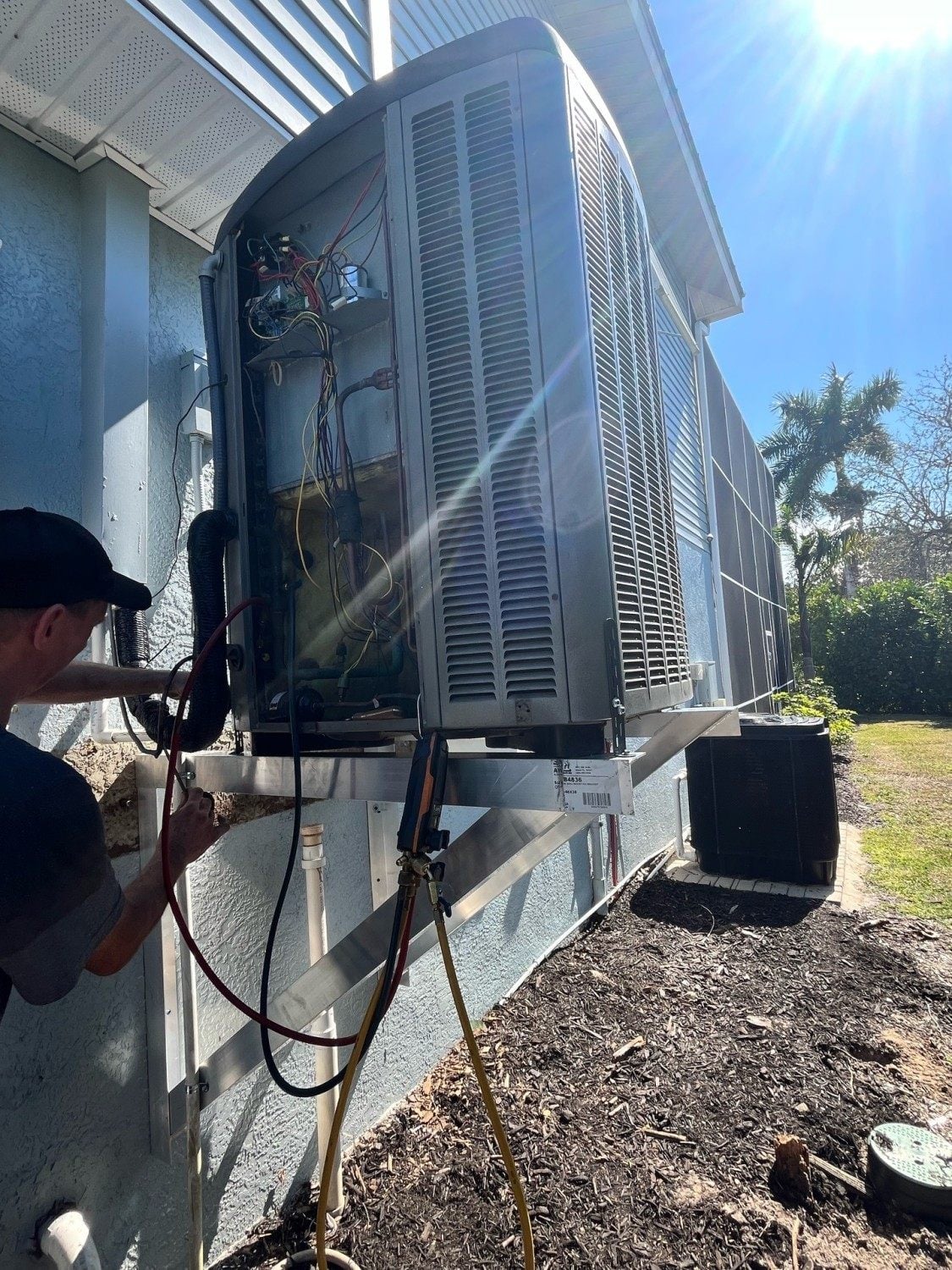
Pro visit #1 · March–April
The spring tune-up: what a real 21-point service covers
Spring is the one that matters most — it’s the pre-season physical before your system runs nearly nonstop through October. A legitimate tune-up is not “spray the coil and leave.” Here’s what our techs actually do:
Coils & Airflow
- Clean evaporator & condenser coils
- Straighten damaged fins
- Measure temperature split across the coil
- Inspect blower wheel & motor amp draw
- Check filter fit and duct returns
Refrigerant & Electrical
- Test refrigerant pressures against spec
- Check for leak signs at line sets & joints
- Meter capacitor readings (the #1 summer failure)
- Test contactor and hard-start components
- Tighten every electrical connection
Drainage & Controls
- Flush the condensate drain line
- Test the float switch (your flood insurance)
- Calibrate the thermostat
- Visual ductwork check for leaks & sweating
- Written report with photos of what we found
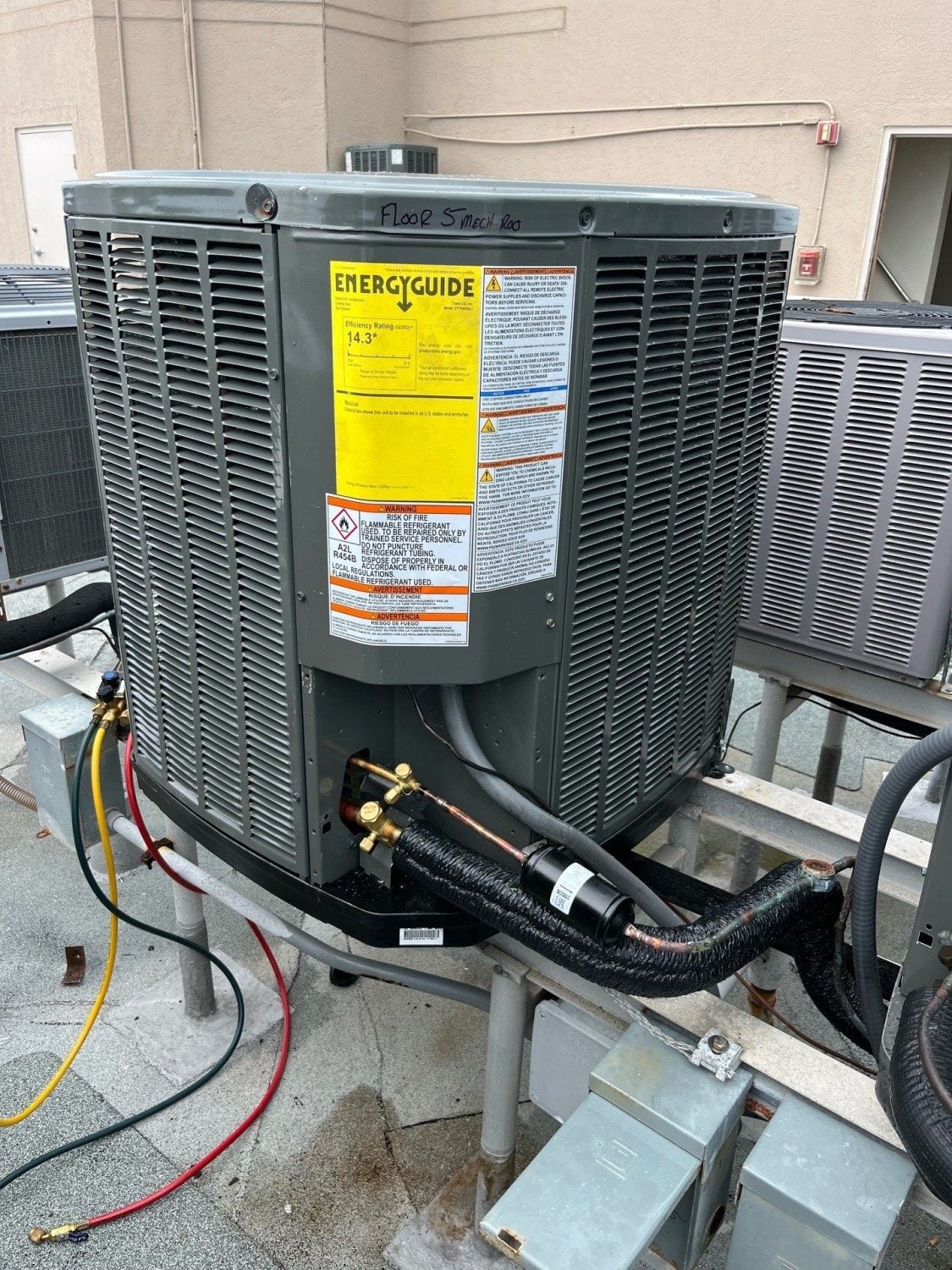
Pro visit #2 · October–November
The fall check: recovery and snowbird prep
Fall is the post-marathon check. Your system just ran the hardest six months of its life — and for a lot of SWFL homes, it’s about to work through the busiest season for guests.
- Heat-strip test. Yes, even here. On the three January mornings you flip to heat, you want the electric strips to work — not smoke. We test amp draw and burn off the summer’s dust safely.
- Post-summer wear check. Capacitors, motors, and refrigerant levels get re-verified after months of nonstop duty.
- Salt-air corrosion inspection. Coastal condensers in Naples and Marco Island corrode fast. We catch coil and cabinet corrosion before it becomes a leak.
- Snowbird-season prep. Arriving in November to a house that sat humid all summer? We verify humidity control, drain flow, and thermostat scheduling so the house is ready before you are. Out-of-state owners get the report by email.
- Hurricane-season debrief. If the unit rode out a storm, we check the pad, lines, and disconnect. More in our hurricane prep guide.
Why bother
The $80 problem before the $800 breakdown
Fewer Emergencies
A weak capacitor caught in April is a quick swap. The same capacitor in August is a 95° house, an emergency call, and sometimes a cooked compressor.
Lower FPL Bills
Dirty coils and low refrigerant make the system run longer to do the same job. Clean, tuned systems cycle less — you see it on the next bill.
More Years Per System
Florida heat already shortens AC lifespans. Maintained systems reliably outlast neglected ones — see how long ACs last in Florida.
★★★★★ 4.9 from 127+ Google reviews — a lot of them start with “our maintenance visit caught…”
The honest boundary
What you should never open yourself
Fair game for homeowners
- Filters, vinegar in the drain line, clearing plants
- Rinsing condenser fins gently with a garden hose (power off first, never a pressure washer)
- Thermostat batteries and settings
Leave to a licensed tech
✕
Anything electrical. Capacitors hold a charge even with power off. They can and do put people in the ER.
✕
Refrigerant. Handling it requires EPA certification, and “topping off” a leaking system just feeds the leak.
✕
Coil cleaning inside the air handler. Bent fins and soaked electronics turn a cleaning into a repair bill.
We’d rather teach you the safe stuff than sell you a mystery. Every plan visit ends with a written report and a walkthrough of what we found. That’s the deal — no commission techs, no invented problems. If something does break between visits, our repair crew answers 24/7.
The easy button
Or skip the calendar reminders entirely
Our maintenance plan covers both seasonal visits — the full checklist above, done by licensed techs, with priority scheduling and repair discounts when something does wear out. We call you when it’s time. You never think about it.
FL Lic. CAC1820344Licensed & InsuredFamily-Owned
Straight answers
Florida AC Maintenance FAQs
How often should AC be serviced in Florida?
Twice a year — a spring tune-up before cooling season and a fall check after it. Northern homes get away with once because their systems idle half the year; a SWFL system runs roughly 10 months and racks up double the wear.
When is the best time to schedule a tune-up?
March–April for spring and October–November for fall. Book before the first 90° week — once the season hits, every AC company in Naples, Cape Coral, and Fort Myers is running emergency calls and tune-up slots vanish.
How often should I change my filter in Florida?
Every 30–60 days during cooling season, monthly if you have pets or run the system hard. The 90-day rating on the package assumes northern usage. A cheap pleated filter changed often beats an expensive one left in too long.
Is a maintenance plan worth it in Florida?
If it includes both seasonal visits, priority scheduling, and repair discounts, usually yes — one prevented emergency call typically covers the annual cost. What’s not worth it: “free tune-up” offers from commission-driven companies, where the visit is a sales audition. Ask what’s actually on the checklist.
Why does my drain line keep clogging?
Florida humidity means your AC pulls gallons of water out of the air daily, and warm, wet PVC grows algae fast. Monthly vinegar keeps it clear; a pro flush at each tune-up clears what vinegar can’t. Full details in our drain line guide.
Can maintenance really extend how long my AC lasts?
Yes. Heat, humidity, and salt air already push Florida systems toward the short end of the 10–15-year range. Clean coils, correct refrigerant charge, and tight electrical connections reduce strain on the compressor — the part whose failure usually ends a system’s life.
Two visits. Zero surprises.
Put your AC on the schedule
- Fastest: call (239) 977-2010 — real person, 24/7
- Easiest: text us at the same number
- Form: tell us your system’s age, we’ll take it from there
Serving Naples, Cape Coral, Fort Myers, Bonita Springs, Estero & Marco Island.
FL Lic. CAC1820344★ 4.9 on GoogleFamily-Owned