
Processing...
Troubleshooting Guide · Yes, Ice Happens in Florida
Why is my AC freezing up?
It’s 93° outside and there’s a block of ice on your air conditioner. Not a malfunctioning fluke — a symptom with exactly two root causes. Here’s what’s happening, how to thaw it without wrecking anything, and which cause you can fix yourself.
Real person answers 24/7 · Naples, Cape Coral & Fort Myers
Why a machine built for heat grows ice
Your AC doesn’t make cold air. It moves heat. Refrigerant flows through the indoor evaporator coil at low pressure, which makes the coil very cold, and the blower pushes your warm, humid house air across it. The air gives up its heat, the refrigerant carries that heat outside, and the coil stays just above freezing as long as warm air keeps flowing over it.
That last part is the whole story. The warm air passing over the coil is what keeps the coil from dropping below 32°. Take that heat away and the coil temperature falls below freezing, the Florida humidity condensing on it turns to frost, frost blocks more airflow, and the freeze feeds itself. An hour later you’ve got an ice block in the swamp.
Only two things break the balance:
- Not enough warm air reaching the coil. A clogged filter, blocked vents, a dirt-caked coil, or a weak blower starves the coil of heat. This is the cause in most freeze-ups, and it’s usually fixable without a truck in your driveway.
- Not enough refrigerant in the coil. A leak drops the pressure, and lower pressure means a colder coil — cold enough to freeze even with perfect airflow. This one needs a licensed tech, and we’ll explain why topping it off isn’t a fix.
Either way, the ice itself is step one. Thaw first, diagnose second.
Do this now — before anything else
The safe thaw procedure
A frozen system can’t be diagnosed and shouldn’t be run. Whether you fix the cause yourself or call us, the thaw comes first, and there’s a right way to do it.
1
Cooling OFF
At the thermostat, switch the system from COOL to OFF. This stops refrigerant from flowing through the iced coil. Every minute it keeps running frozen is a minute of risk to the compressor.
2
Fan ON
Set the fan from AUTO to ON. The blower now pushes room-temperature air across the ice, melting it from the inside out — hours faster than letting it sit.
3
Towels down
All that ice becomes water, and the condensate drain may not keep up. Lay towels around the air handler and check the drain pan so the melt doesn’t find your drywall or flooring.
4
Wait it out
A light frost clears in 2–3 hours; a fully iced coil can take up to 24. Don’t rush it, and do not chip, pry, or hair-dry the ice. The coil is soft aluminum and copper — one slip creates the refrigerant leak you were hoping you didn’t have.
While it thaws, work through the airflow causes below. If you find one and fix it, you may be done. If you don’t, the odds shift toward refrigerant, and that’s a phone call.
The causes you can fix yourself
Airflow problems: check these four
Clogged air filter
The number-one freeze-up cause we find. In Florida’s 10-month cooling season a filter clogs in 4–6 weeks, not the 90 days the package claims. Hold it up to a light: can’t see through it, replace it. If your last change was before the last FPL bill, this is probably your answer.
Blocked return grilles
The big grilles that pull air in are half the airflow equation. A sofa pushed against the wall return, a bookcase in front of a hallway grille, or a return blocked off in a room conversion all starve the coil. Give every return a clear foot of breathing room.
Closed supply vents
Closing vents in spare rooms feels thrifty, but the system was sized to push air through all of them. Choke off enough registers and the airflow across the coil drops below the freeze line. Open every vent, including the guest room the snowbirds’ grandkids use twice a year.
Dirty evaporator coil
Years of dust, pet hair, and Florida’s airborne mildew coat the coil fins until air can’t pass and heat can’t transfer. You can look for visible grime at the coil face, but cleaning it right means opening the air handler — that one’s part of a proper maintenance visit, not a Saturday DIY.
Found and fixed one? Let the coil thaw completely, switch back to COOL, and watch it for a day. No ice, cold vents — you’re done. Freezes again with clean filter, open vents, and clear returns? Keep reading, because that’s the other cause.
The cause that needs a licensed tech
Low refrigerant: why it WILL refreeze
Refrigerant isn’t fuel. It doesn’t get used up, burned off, or “run low” with age. It circulates in a sealed loop, so if the system is low, the refrigerant leaked out — and in SWFL, where salt air eats coil copper faster than anywhere up north, leaks are a matter of when, not if.
Here’s the physics again: less refrigerant means lower pressure in the evaporator coil, and lower pressure means a colder coil. Below 32°, the coil ices no matter how clean your filter is. You can thaw it ten times; it will freeze ten times, usually a little faster each round as the charge keeps escaping.
The straight talk on “topping it off”: plenty of companies will gladly add refrigerant every season and wave from the driveway. We won’t. Gas without a leak repair escapes through the same hole you just paid to fill — it’s renting cold air by the pound, forever. The honest fix is finding the leak, repairing or replacing the leaking component, pulling a vacuum, and weighing in the factory charge. Done once, done right. If the leak is in an aging coil on a 14-year-old system, we’ll show you the repair-vs-replace math in writing and let you decide — that comparison lives in our Florida repair cost guide too.
Suspect a leak? That’s a job for gauges, a leak detector, and an EPA certification. Our AC repair service covers exactly this, same-day across Collier and Lee County.
The expensive mistake: running it frozen
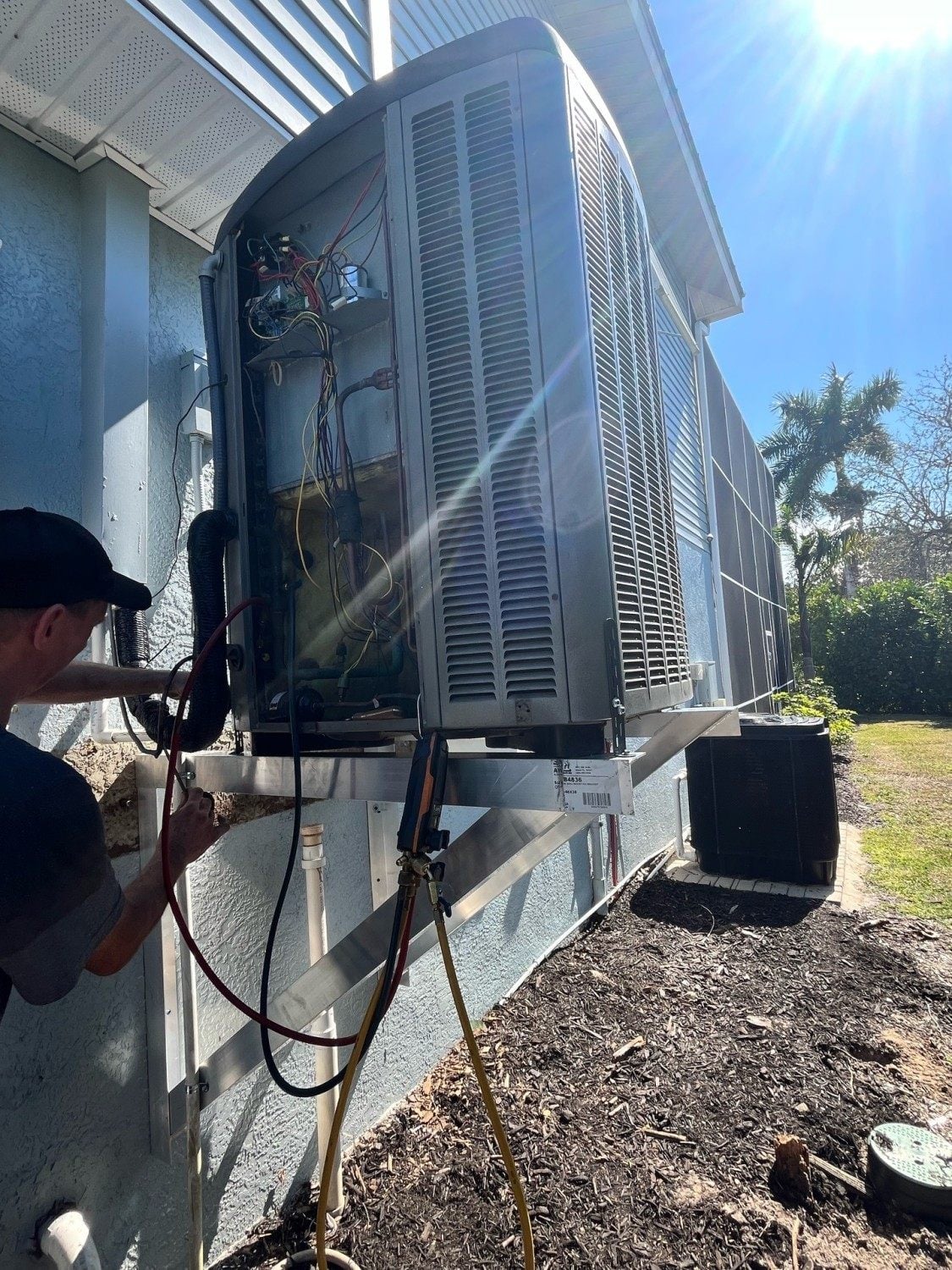
The compressor outside is built to pump refrigerant vapor. When the evaporator coil is iced over, refrigerant stops boiling into vapor and can slug back to the compressor as liquid — and liquid doesn’t compress. It hammers valves, washes out lubricant, and grinds down the one component that costs more than everything else in the system combined.
That’s how a $30 filter problem becomes a four-figure compressor replacement. If you notice ice, or the vents blow warm while the unit runs and runs (a frozen coil is one reason an AC runs constantly, and a common cause of warm air at the vents), shut cooling off. The house will be sticky for a few hours. The compressor will live.
Frozen twice, or not sure which cause you’ve got? Diagnosis first, written flat-rate quote second, your decision always.
☎ Call (239) 977-2010 — We’ll Walk You Through It
Or text a photo of the iced line to the same number
Frozen-AC questions, straight answers
AC freezing up FAQs
How long does it take a frozen AC to thaw?
With cooling OFF and the fan set to ON, light frost clears in 2–3 hours and a fully iced coil can take up to 24. Without the fan running, add hours. Never chip or pry the ice — the coil dents and punctures easily, and a punctured coil is a refrigerant leak.
Can I pour hot water on the ice to speed it up?
Skip it. Hot water on the outdoor lines does little, and inside the air handler it floods the drain pan faster than the condensate line can carry it away, which risks water damage and a tripped float switch. The blower moving room air across the coil is the safe accelerant.
Why does my AC freeze up only at night?
Cooler overnight air lowers the load on the system, so the coil runs colder for longer stretches. A system that’s marginal — filter half-clogged or charge slightly low — crosses the freeze line at 3am before it ever would at 3pm. Night-only freezing is an early warning, not a pass.
My filter was filthy. Am I done after changing it?
Probably, if it stays ice-free for a couple of days of normal running. Mark your calendar: in a Florida cooling season, filters need changing every 4–6 weeks. Twice-a-year professional AC maintenance catches the slower freeze-up causes — dirty coils, weak blowers, low charge — before the ice does.
I changed the filter and it froze again. Now what?
With a clean filter, open vents, and clear returns, a repeat freeze points at low refrigerant or a dirty coil/failing blower — all diagnoses for a licensed tech with gauges. Shut cooling off, let it thaw, and call. Running it through repeat freezes is how compressors die.
Is a frozen AC an emergency?
The ice itself isn’t, because the fix starts with turning the system off. It becomes urgent when the house heats past the high 80s, someone vulnerable is home, or melt water is spreading toward floors or ceilings. We answer Naples, Cape Coral, and Fort Myers calls 24/7 at (239) 977-2010 and give you a real arrival window on the phone.
Thawed, diagnosed, cool
Keeps freezing? We’ll end it
You’ve thawed it and checked the airflow. If the ice comes back, the cause is inside the system, and finding it is our job. See how a visit runs on our AC repair page, or reach out now:
- Fastest: call (239) 977-2010 — 24/7 live answer
- Easiest: text a photo of the iced coil or lines to the same number
- Form: tell us the symptoms, we call you back
FL Lic. CAC1820344★ 4.9 on Google24/7 EmergencyUpfront Flat Pricing