
Processing...
Snowbird Guide · Seasonal Homes
Snowbird AC settings: what to set before you leave Florida
Every April the same question comes up in every SWFL neighborhood: “What do I set the AC to when I leave?” Here’s the straight answer — thermostat, fan, and humidistat — plus everything else that keeps mold out of an empty house from May to November.
Real person answers 24/7 · We service unattended homes across SWFL
First, know what you’re fighting
The enemy isn’t heat. It’s humidity.
A closed-up Florida house doesn’t care that it’s 95° outside. Drywall, tile, and furniture handle heat fine. What they can’t handle is months of air sitting above 60% relative humidity — and from May through October, outdoor air here runs 75–90% humidity around the clock.
With nobody opening doors and no AC cycling, indoor humidity climbs to match outdoors within days. Above 60%, mold has everything it needs. It starts in the closets, on leather furniture, and around supply vents, and it can take over an empty house in a matter of weeks. Remediation bills routinely run into five figures, and insurance often fights mold claims on unoccupied homes.
So the goal of your summer settings isn’t keeping the house cool. It’s keeping it dry. Every setting below serves that one job. If your house already feels sticky while you’re living in it, fix that first — our guide on why a house feels humid with the AC running covers the causes.
The answer everyone asks for
The settings, in plain numbers
Thermostat: 77–80°
Cool enough that the system still cycles and wrings moisture out of the air, warm enough that you’re not paying FPL to chill an empty house. 72° is a waste; “off” is an invitation to mold.
Fan: AUTO, never ON
On AUTO, the blower stops between cycles so condensed water can drain outside. On ON, it blows across the wet coil around the clock and pushes that moisture right back into the house.
Humidistat: 58–60%
If your home has one, this is the star of the show. Set it to 58–60% and it runs the AC only when the air actually gets damp — the cheapest mold insurance in Florida.
No humidistat? Thermostat at 77–80°, fan on AUTO, and you’re covered. The system will cycle enough on humid days to keep the air dry.
The Florida-only setup
How the humidistat + thermostat combo works
Lots of SWFL homes — especially in Marco Island, Naples, and other snowbird-heavy areas — have a small dial next to the thermostat labeled with humidity percentages. That’s a humidistat, and it’s wired in series with the thermostat: the AC only runs when both say yes.
Here’s the summer-away setup:
- Humidistat: 58–60%. This becomes the gatekeeper. Below 58%, the system stays off no matter what.
- Thermostat: about 72°. Yes, lower than you’d expect. Once humidity crosses the setpoint, the thermostat decides how long the system runs — a lower number buys a nice long drying cycle instead of a short, useless one.
The result: the AC ignores temperature all summer and runs only when moisture builds up. On a rainy August week it may run daily; during a dry stretch, barely at all. Your FPL bill drops and the house stays dry. Just remember to set the humidistat back to OFF (or 100%) when you return, or the house will feel warm no matter what the thermostat says.
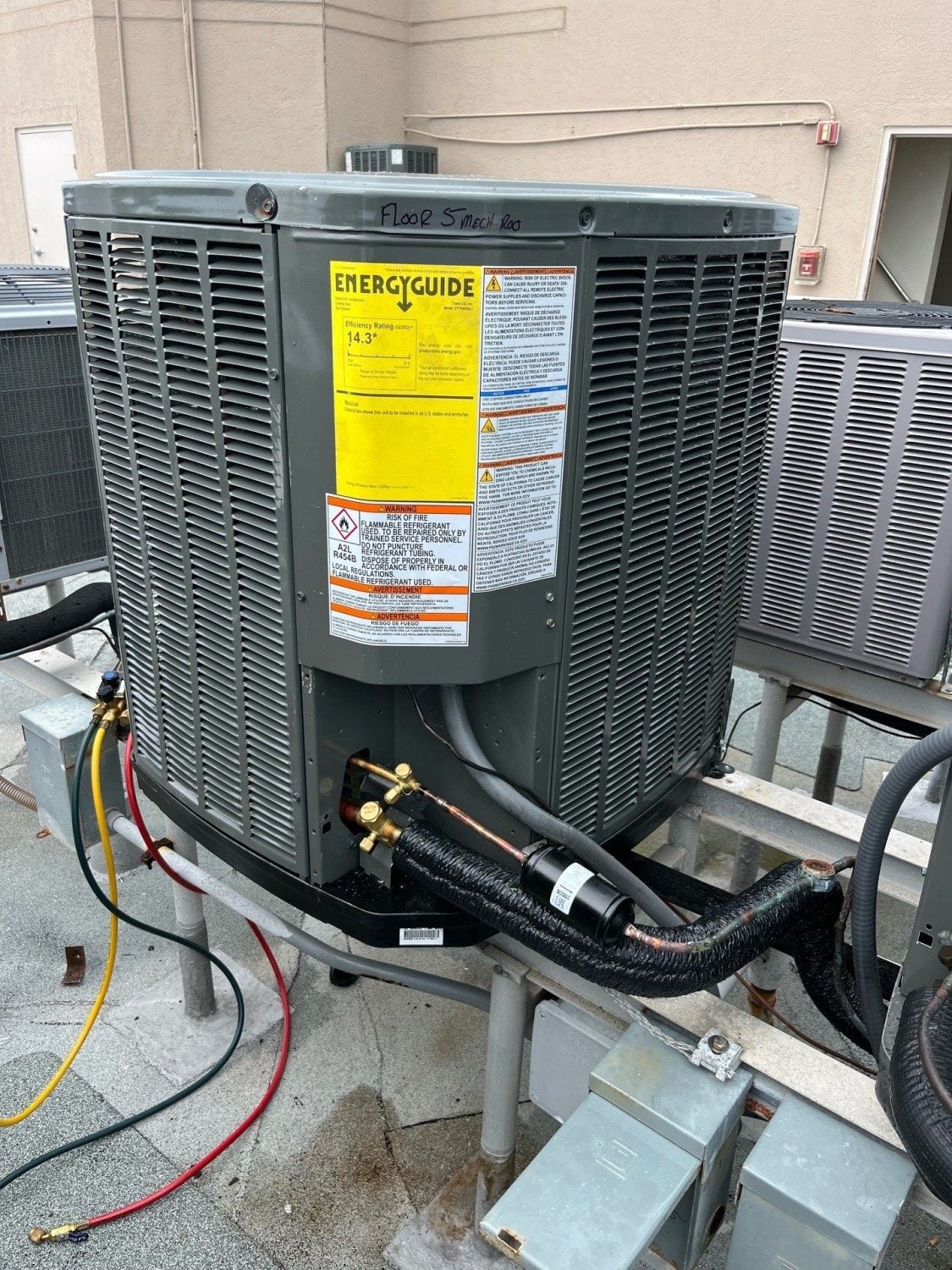
Settings are half the job
The lock-up checklist beyond the thermostat
1
Fresh filter
A clogged filter chokes airflow and cuts the coil’s drying power for six straight months. Put in a clean one the week you leave.
2
Flush the drain line
Six months of condensate with nobody watching is how ceilings get ruined. Flush it before you go — our drain line guide shows how, and confirm the float switch actually shuts the system off.
3
Surge protection
SWFL is the lightning capital of the country, and summer is the season. A whole-home or condenser surge protector keeps a July storm from cooking a compressor board while you’re 1,200 miles away.
4
Shut off the water
At the main valve. A burst supply line in an occupied house is a mess; in an empty one it’s a demolition. Water off also means the AC drain is the only water risk left.
5
Crack interior doors
Leave bedroom and closet doors open a few inches so conditioned air reaches every room. Closed-off rooms become humidity pockets — and that’s where mold starts.
6
Blinds closed
Closed blinds and curtains cut solar heat gain, which lowers the cooling load and protects floors and furniture from six months of hard Florida sun.
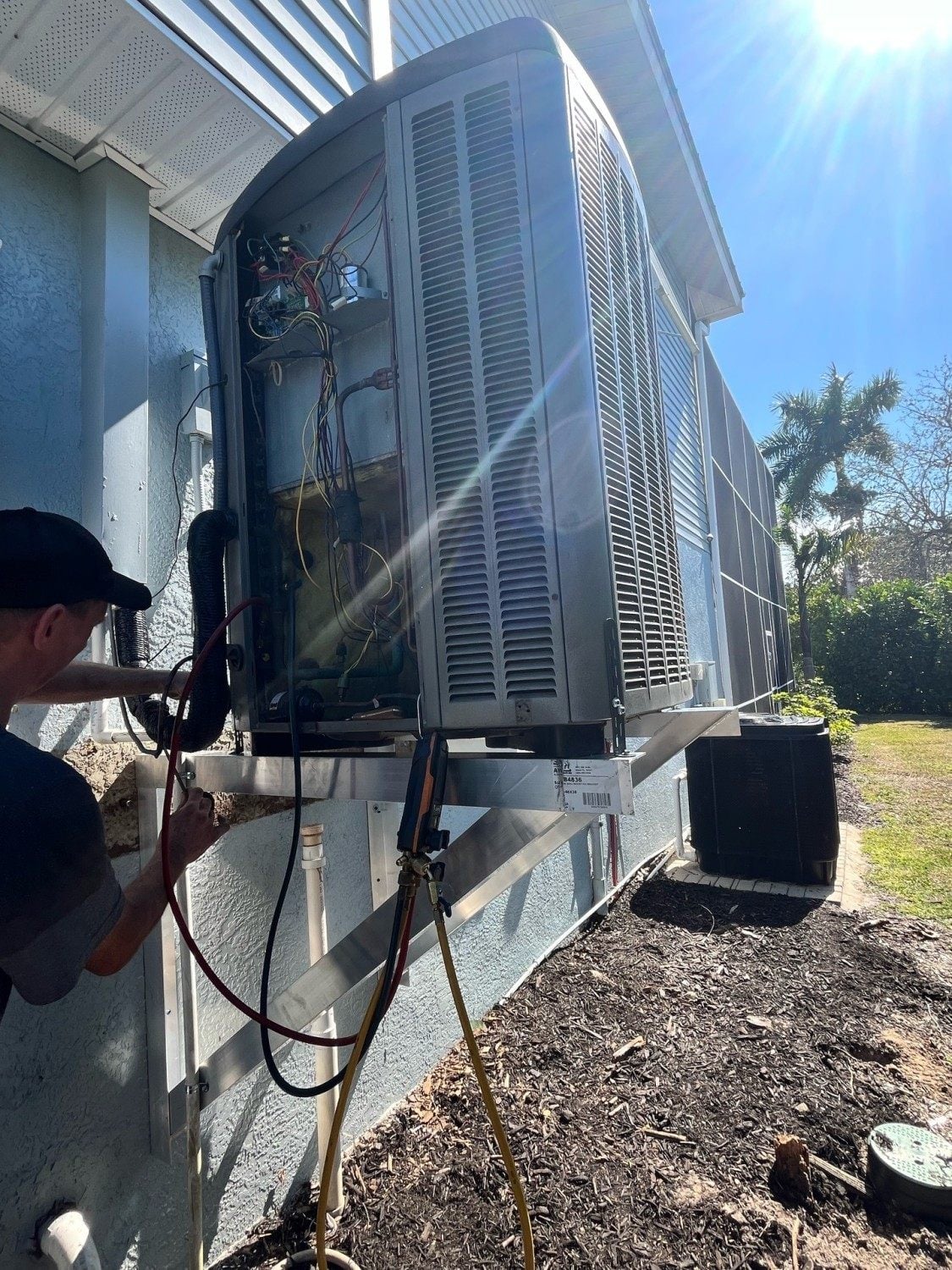
Trust, but verify — from 1,200 miles
Smart monitoring: know before the neighbors smell it
A Wi-Fi thermostat with a humidity sensor turns “hope the house is fine” into a number on your phone. Ecobee, Honeywell, and Nest models all report indoor temperature and humidity, and the good ones send an alert the moment either drifts out of range.
Set two alerts before you leave: humidity above 65% and temperature above 85°. Either one means the system has stopped doing its job. Then decide who gets that alert — you, and at least one person who’s actually in Florida. An alert that only reaches a phone in Michigan still needs someone here to act on it.
If your system is due for a thermostat anyway, we install and configure Wi-Fi models as part of a maintenance visit, including the alert setup and a test while you watch.
The last piece
Have a local pro on call before you need one
The plan is simple: a trusted neighbor holds a key, and our number goes on the fridge — (239) 977-2010. When the humidity alert fires in July, the neighbor lets us in, and you don’t spend a week finding a contractor from three states away.
We service unattended homes across Naples, Marco Island, Bonita Springs, and the rest of Collier and Lee County every summer, and we know what out-of-state owners worry about: work happening in their house that they can’t see. So we document it. You get photos of what we found, a written flat-rate quote before any repair, and photos of the finished work. Nothing happens to your home without your approval, and nothing is invisible.
FL Lic. CAC1820344★ 4.9 on GooglePhoto ReportsQuote Before Work
Bookend the season
Two tune-ups make the whole plan work
Before you leave (April–May)
The system is about to run unsupervised through the hardest six months of the Florida year. A pre-departure tune-up covers the coil, refrigerant, electrical, drain line, and float switch — so the machine you’re trusting with the house is actually ready.
Before you return (October–November)
Book a check for the week before you fly back. We verify the system survived the summer, reset the humidistat for occupancy, and if anything needs attention you land to a cool, dry house instead of a service call.
Heading north soon? One visit sets the whole system up for the summer: tune-up, drain flush, settings dialed in, and our number on your fridge.
☎ Call (239) 977-2010 — Schedule Before You Fly
Or text your departure date to the same number
Before you pack
Snowbird AC questions, answered straight
What temperature should I set my AC when leaving Florida for the summer?
Set the thermostat between 77° and 80° with the fan on AUTO. If you have a humidistat, set it to 58–60% and the thermostat to about 72° — then the system runs on humidity instead of temperature, which is what an empty house actually needs.
Should I turn my AC off completely when I leave for six months?
No. In Southwest Florida, an AC that’s off means indoor humidity matches outdoor humidity within days — 75% and up, all summer. That’s mold territory, and mold remediation costs far more than six months of running the AC at 78°. Keep it on and let it cycle.
What humidity level prevents mold in an empty house?
Keep indoor humidity below 60%. Mold growth accelerates above that line, especially in still air with no one opening doors. A humidistat set to 58–60%, or a Wi-Fi thermostat alerting you above 65%, keeps you on the safe side. Persistent dampness even with good settings is a system problem — see our indoor air quality page for whole-home dehumidifier options.
Why does the humidistat setup use a lower thermostat setting?
Because the two controls are wired in series, the humidistat acts as the on/off gatekeeper and the thermostat controls how long each run lasts. With the humidistat at 58–60%, the AC can’t run until the air is damp — and a thermostat around 72° gives it a long, effective drying cycle once it does. Set the humidistat back to OFF or 100% when you return.
How much does it cost to run the AC in an empty Florida house all summer?
Far less than running it occupied. At 78–80°, or humidistat-controlled, the system runs a fraction of its normal hours — most owners see summer FPL bills well below their in-season bills. The comparison that matters: a modest monthly electric bill versus a five-figure mold remediation.
Who checks on the AC while I’m gone?
Ideally two layers: a Wi-Fi thermostat that alerts you and a local contact, plus a neighbor or property watcher with a key. We service unattended homes across Collier and Lee County — when an alert fires, your key-holder lets us in, and you get photos and a written quote before we touch anything.
Should I get my AC serviced before leaving for the summer?
Yes — it’s the single best thing on this list. The system is about to run six months with no one listening for odd noises or watching for leaks. A pre-departure tune-up catches weak capacitors, dirty coils, and slow drains before they become an empty-house emergency in July. Book it 2–4 weeks before you leave.
Leave cool, come back dry
Set your house up for the summer
One pre-departure visit: full tune-up, drain line flushed, thermostat and humidistat set, alerts tested, our number on the fridge. Then go enjoy your summer — the house is handled.
- Fastest: call (239) 977-2010 — 24/7 live answer
- Easiest: text your departure date to the same number
- Form: tell us when you’re leaving, we call you back
FL Lic. CAC1820344★ 4.9 on GoogleLicensed & InsuredFamily-Owned