
Processing...
Troubleshooting Guide · Water Where It Shouldn’t Be
AC leaking water? What to do right now
There’s water around your air handler and it’s spreading. In a Florida house that’s a race against drywall, not just a puddle. Three moves stop the damage in the next five minutes — then we’ll show you what’s actually leaking and whether you can fix it yourself.
Real person answers 24/7 · Naples, Cape Coral & Fort Myers
Do these three things first
Stop the damage in five minutes
Don’t diagnose yet. Water spreads while you Google. Contain it first — the cause will still be there in ten minutes.
1
Kill the power
Flip the switch on or next to the air handler — it looks like a light switch — or shut off the AC breaker. This stops the system from making more water and protects the electronics sitting inches from the puddle.
2
Towel up
Towels around the base of the unit, and get anything cardboard or wooden out of the closet or garage bay. If the air handler is in the attic, put a bucket under the ceiling drip and don’t poke the wet drywall.
3
Check the drain pan
Look under the indoor unit with a flashlight. Pan full or overflowing? That’s a blocked drain — the most common cause, covered next. Pan bone-dry while water pools elsewhere? The water’s taking a different route, and that detail helps whoever fixes it.
Water reaching ceilings, wood floors, or spreading fast? Skip ahead and call. Our emergency AC repair line answers 24/7, and a clogged drain is usually a same-visit fix.
Where the water comes from
Why Florida ACs leak: the four causes
Your AC is a dehumidifier that happens to cool. On a humid SWFL day it pulls 5–20 gallons of water out of your air, and every drop is supposed to leave through one small PVC pipe. When water shows up on the floor instead, one of four things went wrong.
1. Clogged condensate line — the #1 cause
That PVC drain line stays wet year-round in Florida’s humidity, and a warm, wet, dark pipe grows algae like a science project. The sludge chokes the line, water backs up into the pan, and the pan overflows. This is the cause in most of the leak calls we run, and it’s the one you may be able to clear yourself — our drain line guide walks through the DIY flush.
2. Frozen coil melt-off
A dirty filter or a refrigerant leak can ice the indoor coil into a block. When the ice lets go, it melts faster than the drain can swallow — and suddenly there’s a flood that “came out of nowhere.” If you saw frost on the copper lines, or the vents blew warm before the water showed up, read why ACs freeze up next, because the leak is the symptom, not the problem.
3. Rusted-through drain pan
Under older air handlers sits a metal pan that’s been catching acidic condensate for 10–15 years. Eventually it rusts through and drips from underneath even when the drain line is clear. Common on systems past the decade mark — the pan gets replaced, and it’s worth an honest look at the rest of the aging unit while the panel’s open.
4. Disconnected or cracked line
PVC joints that were dry-fit instead of glued, a fitting knocked loose by a stored suitcase, or a line cracked during a rough install — the water never reaches the drain at all. The giveaway is a dry pan with a wet floor. A tech re-routes, re-glues, and re-slopes it so gravity does its job.
“My AC leaked, then shut off and won’t restart”
The float switch: that’s it working
Most Florida systems have a small safety device on the drain pan or riding in the drain line: the float switch. When backed-up water lifts the float, it cuts power to the system — the same way the float in your toilet tank stops the fill.
So if your AC dripped and then went dead, it probably wasn’t a second failure. The switch saw the flood coming and pulled the plug before the pan overflowed onto your floor. Annoying at 9pm in August, but it likely saved you a drywall repair.
Do not bypass it. We find float switches unclipped or jumpered out by a previous “fix” more often than we’d like, and every one of them is a flood with a countdown. The switch isn’t the problem; the water that tripped it is. Clear the drain, the pan empties, the float drops, and the system runs again.
No float switch on your system? Worth adding — it’s an inexpensive part during a maintenance visit, and it’s the only thing standing between a clogged line and your ceiling if the unit’s in the attic.
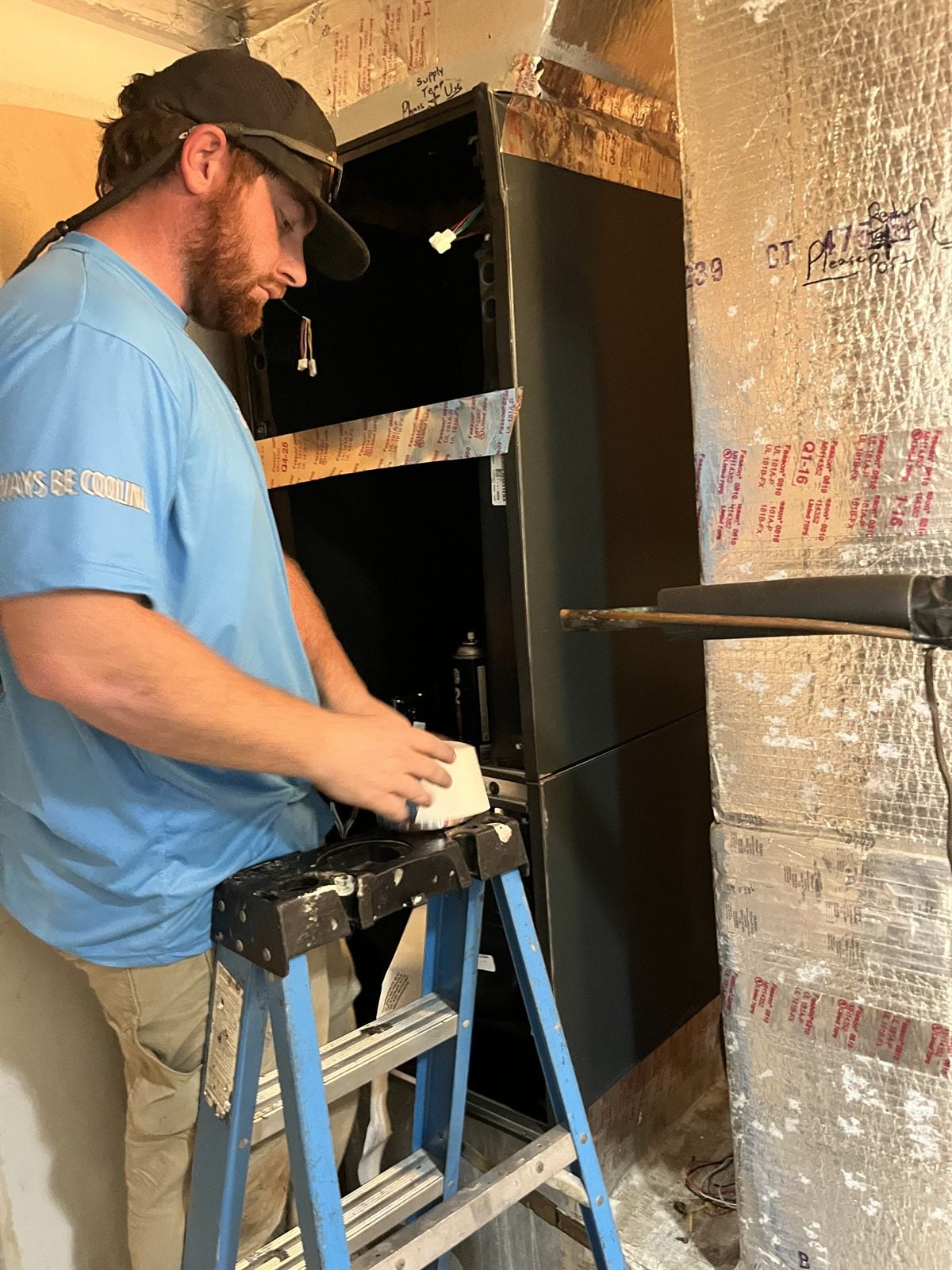
Florida’s clock: mold in about 48 hours
Up north, a small AC leak is a mop-up. Here it’s a deadline. Mold needs moisture, warmth, and something to eat — and wet drywall in an 80°-plus, humid house is all three. Growth can start in as little as 24 to 48 hours, inside the wall where you can’t see it.
That’s why “I’ll deal with it this weekend” is the expensive answer. The AC fix might be a $20 bottle of vinegar or a straightforward service call; the remediation for a moldy wall cavity is another category of bill entirely, and it starts with cutting out drywall.
If water touched drywall, baseboards, or carpet: dry it aggressively today. Fans on it, dehumidifier if you have one, baseboards pulled away from soaked sections so the wall cavity can breathe. Musty smell a few days later, or paint bubbling? Get a mold assessment — that’s beyond an AC fix.
The fix, done right
What our tech actually does about it
Clear and flush the line
We clear the clog with a shop vac at the outside termination or nitrogen pressure through the line, then flush the full run to confirm water moves freely from pan to exit — not just enough to stop today’s drip.
Treat against regrowth
Time-release condensate tablets go in the pan to keep algae from rebuilding the same sludge by October. We check the trap and cleanout tee while we’re in there, and add a cleanout if the line never got one.
Reseat pan, test the switch
The drain pan gets leveled and reseated so water runs toward the drain instead of the rim, the float switch gets tested, and we inspect for rust-through and coil issues so the leak doesn’t come back wearing a different hat.
Keeping it from happening again
A cup of white vinegar down the line’s cleanout every month or two keeps algae from re-forming — the full how-to lives in our clogged drain line guide. And twice-a-year AC maintenance includes the drain flush, pan check, and float-switch test every visit, which is why our maintenance customers almost never make this particular 9pm phone call.
Water still coming, or don’t want to gamble on the drywall? Diagnosis first, written flat-rate quote second, your decision always.
☎ Call (239) 977-2010 — We’ll Walk You Through It
Or text a photo of the leak to the same number
Leaking-AC questions, straight answers
AC water leak FAQs
Can I keep running my AC while it’s leaking?
Don’t. Every hour it runs, it pulls more gallons out of the humid air and sends them toward your floor. If the leak traces to a frozen coil, running it can also destroy the compressor. Shut it down at the switch or breaker, contain the water, then diagnose or call.
Is water leaking from my AC dangerous?
The water is just condensate — clean enough, not sewage. The danger is what it lands on: electronics in the air handler, and drywall or subfloor where Florida mold can take hold within about 48 hours. Treat the mess as urgent even though the water itself is harmless.
How much does fixing an AC leak cost?
A condensate line clear-and-flush sits at the affordable end of AC repairs; a new drain pan or float switch costs more but stays reasonable; a frozen coil caused by a refrigerant leak is the expensive branch. Either way you get a written flat-rate quote after diagnosis, before any work — that’s how every repair visit runs.
Why does my AC only leak when it rains?
Then it’s probably not condensate. Rain-timed water points at the roof penetration around the refrigerant lines, a rooftop or attic duct sweating, or wind-driven rain reaching the air handler closet. Still worth a call, but you may need a roofer alongside an AC tech — we’ll tell you which honestly.
My AC shut itself off after leaking. Is it broken?
Probably the opposite — the float switch detected backed-up water and cut power on purpose to stop an overflow. Clear the drain blockage (or have us clear it), the pan drains, and the system comes back on its own. Don’t bypass the switch to force it to run.
Can I clear the drain line myself?
Often, yes. If you can find the line’s outside termination, a wet/dry vac sealed to the pipe end for a minute or two pulls most algae clogs out, and monthly vinegar keeps them gone. The full step-by-step is in our drain line guide. If the clog won’t move, the pan is rusted, or the unit’s in the attic, that’s our job.
Dry floor by tonight
Still leaking? We’ll stop it today
You’ve killed the power and contained the water — the hard part left is finding the cause and fixing it once. See how a visit runs on our AC repair page, or reach out now:
- Fastest: call (239) 977-2010 — 24/7 live answer
- Easiest: text a photo of the leak to the same number
- Form: tell us what you’re seeing, we call you back
FL Lic. CAC1820344★ 4.9 on Google24/7 EmergencyUpfront Flat Pricing